Your staff signed the policy.That doesn't mean they follow it.
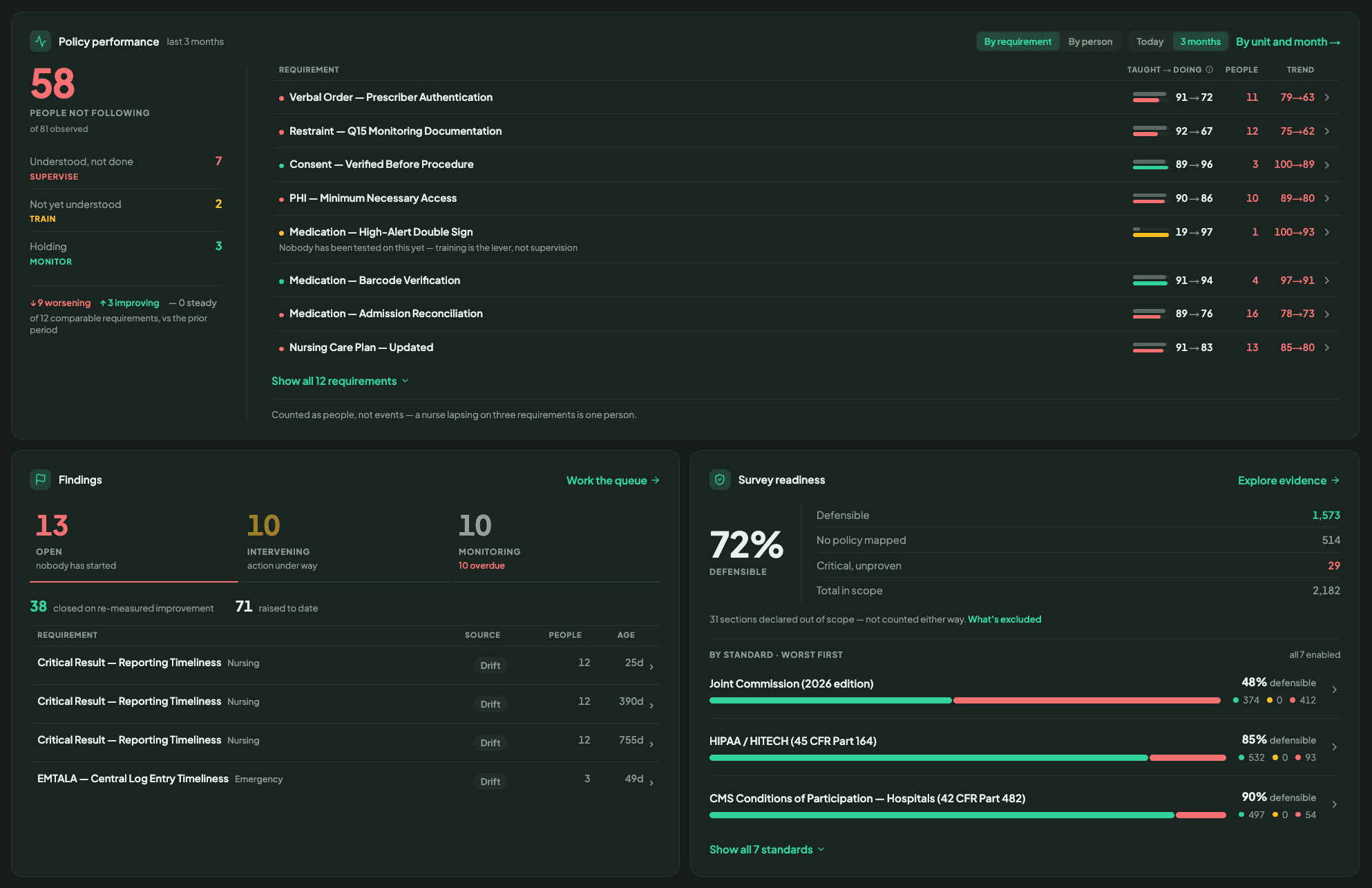
Demo facility data
Oromis helps healthcare leaders track and prove which of their staff understand and follow policies on the floor.
Leadership is flying blind
on the floor.
Three things you can say about a policy. Most facilities can only say the first two.
Attested
Every facility has this.
It proves receipt, and nothing else.
Trained
Facility-specific policy training, by role, is rare.
Live training proves attendance, not understanding.
Followed
Where you actually stand, before a survey rather than after.
No system shows you this today.
The first two tell you about your paperwork. Only the third tells you what affects a patient.
5.9%
lower 30-day mortality while surveyors were in the building — then back to baseline. Practice changes when someone is watching.
52%
of surveyed hospitals had a condition-level deficiency — a whole domain failing, not a single finding. Up from 32% two years earlier.
“All noted noncompliance must be cited even when corrected on site during the survey.”
CMS State Operations Manual, Appendix A — Scrambling once they are in the building does not save you. Only being ready before they arrive does.
Your policies and your data,
measured against the standards.
You send what you already have. Oromis maps it to the standards you're judged against and produces what your team hands over.
The standards you're judged against
What you send
Oromis
maps every policy and event to the requirement it answers
What you get
Training is generated from your own policies per role, or pulled from the LMS you already run. The practice export carries no patient identifiers.
Reports no one else can produce.
Pull-ready, not manual.
On the left, what Oromis generates.On the right, what producing it by hand costs you today.
Understood it. Not doing it.
Demo dataJ. Okonkwo · RN · ICU
understood · not done
M. Haddad · RN · 4-West
understood · not done
S. Reyes · LPN · ED
understood · not done
Live, per requirement and per person — the cohort your training is already reaching and still not changing.
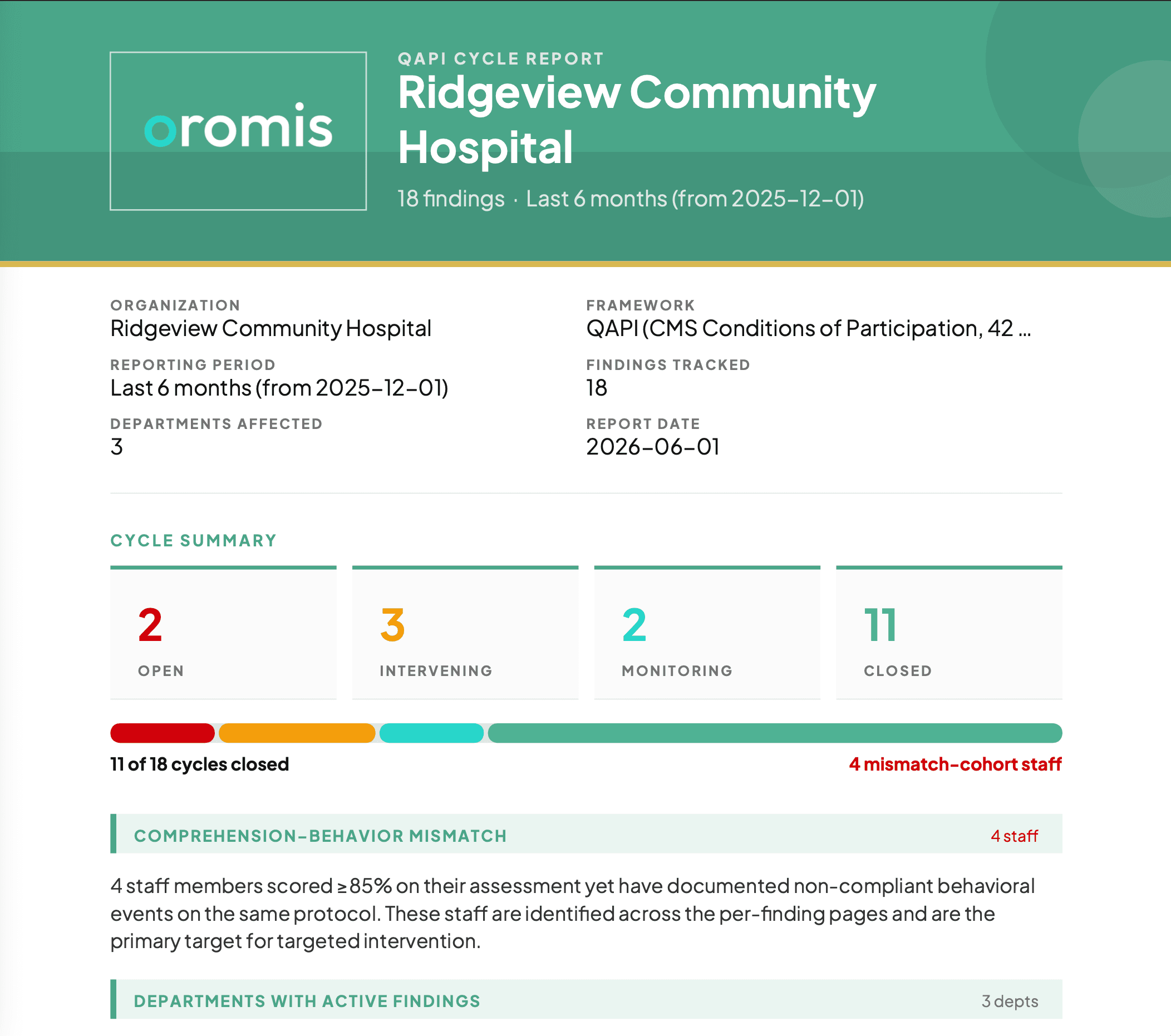
Every requirement mapped to the standard it's judged against, exported as one binder — filterable to a single unit or an overnight shift, version-pinned and de-identified.
By hand, today
$54,540 / year
606 leadership hours × $90/hr
0.3h each
78 h
2h each
96 h
5h each
60 h
13h each · ≈40 charts at the OIG's ~20 min per chart
156 h
18h each
72 h
10h each
40 h
40h each
40 h
4h each
64 h
Total
606 h · $54,540
Real files built from demo facility data, formatted the way a surveyor expects them.
Every system holds half the answer.
None of them hold both.
You have probably bought all four already. Each one is good at its job.
| System | Attested | Trained | Followed | Per requirement | Joined |
|---|---|---|---|---|---|
| Your LMS | Signed for — receipt recorded: no | Training delivered and completion recorded: yes | What actually happened on the floor: no | Tracked at the single requirement, not the whole policy: no | Both halves for the same named person — understood, and done: no |
| Your policy manager | Signed for — receipt recorded: yes | Training delivered and completion recorded: no | What actually happened on the floor: no | Tracked at the single requirement, not the whole policy: no | Both halves for the same named person — understood, and done: no |
| Your EHR | Signed for — receipt recorded: no | Training delivered and completion recorded: no | What actually happened on the floor: partly | Tracked at the single requirement, not the whole policy: no | Both halves for the same named person — understood, and done: no |
| Your incident & audit system | Signed for — receipt recorded: no | Training delivered and completion recorded: no | What actually happened on the floor: partly | Tracked at the single requirement, not the whole policy: partly | Both halves for the same named person — understood, and done: no |
| Oromis | Signed for — receipt recorded: yes | Training delivered and completion recorded: yes | What actually happened on the floor: yes | Tracked at the single requirement, not the whole policy: yes | Both halves for the same named person — understood, and done: yes |
● yes◐ partly— no
Per requirement — tracked at the single requirement, not the whole policy. Joined — both halves for the same named person: what they understood, and what they did.
Oromis reads all four and keys them to the same requirement. For any requirement, you can see who was trained on it, who understood it, and who is doing it on the floor.
It sits on top of the systems you already run. Nothing gets replaced.
Start with one policy.
Extend it when it works.
Every engagement starts small and earns its way to the next stage.
28-day pilot
01Pick one policy. Prove it end to end.
- One high-risk policy, one cohort of about 25 staff
- Mapped to the standards it's judged against
- Role-specific training built, comprehension measured
- Cross-tabulated against what happened on the floor
Facility rollout
02Extend it once you've seen the results.
- Every high-risk policy, every unit
- Staff and roles mapped
- Your EHR and LMS connected
- One evidence index for the whole facility
Standing system
03It keeps itself current.
- New hires picked up automatically
- Policy versions tracked as they change
- Evidence stays current between surveys
- Nothing to assemble the week before
We'll confirm which policy to start with, and whether it fits your survey cycle.
Built for a hospital's data rules
Your policies and your staff records are sensitive. We treat them that way.
No PHI reaches Oromis
The practice export is de-identified before it leaves your system. We ingest policies and events, never patient records.
HIPAA-informed controls
Built to the Security Rule's safeguards. We do not claim certification — a formal audit is on the roadmap, not behind us.
Historical records retained
When a surveyor asks about something from eighteen months ago, your team can pull it. Retrievable by policy, person, or date.
Traceable to your own source
Every row points back to the document or export it came from, so a surveyor can cross-check any figure against your system.
Role-based access
A unit manager sees their unit. Encrypted at rest and in transit, with an append-only audit log.
Oromis is an analysis layer, not a source system. It does not alter clinical records, and it does not produce CMS-submittable documentation — it produces the internal evidence that supports it.
“You know how many people actually read the policy? Probably no one.”
— Chief Nursing Officer, 30 years in healthcare leadership, former HHS/ONC
Proof they followed it.
Before anyone asks.
See what Oromis produces — the mismatch report and the survey export your team hands across the table. Straight to your inbox.